 OGExamPrep
CFA Level 1 90-Day Study Plan: How I Prepared From Scratch
Published
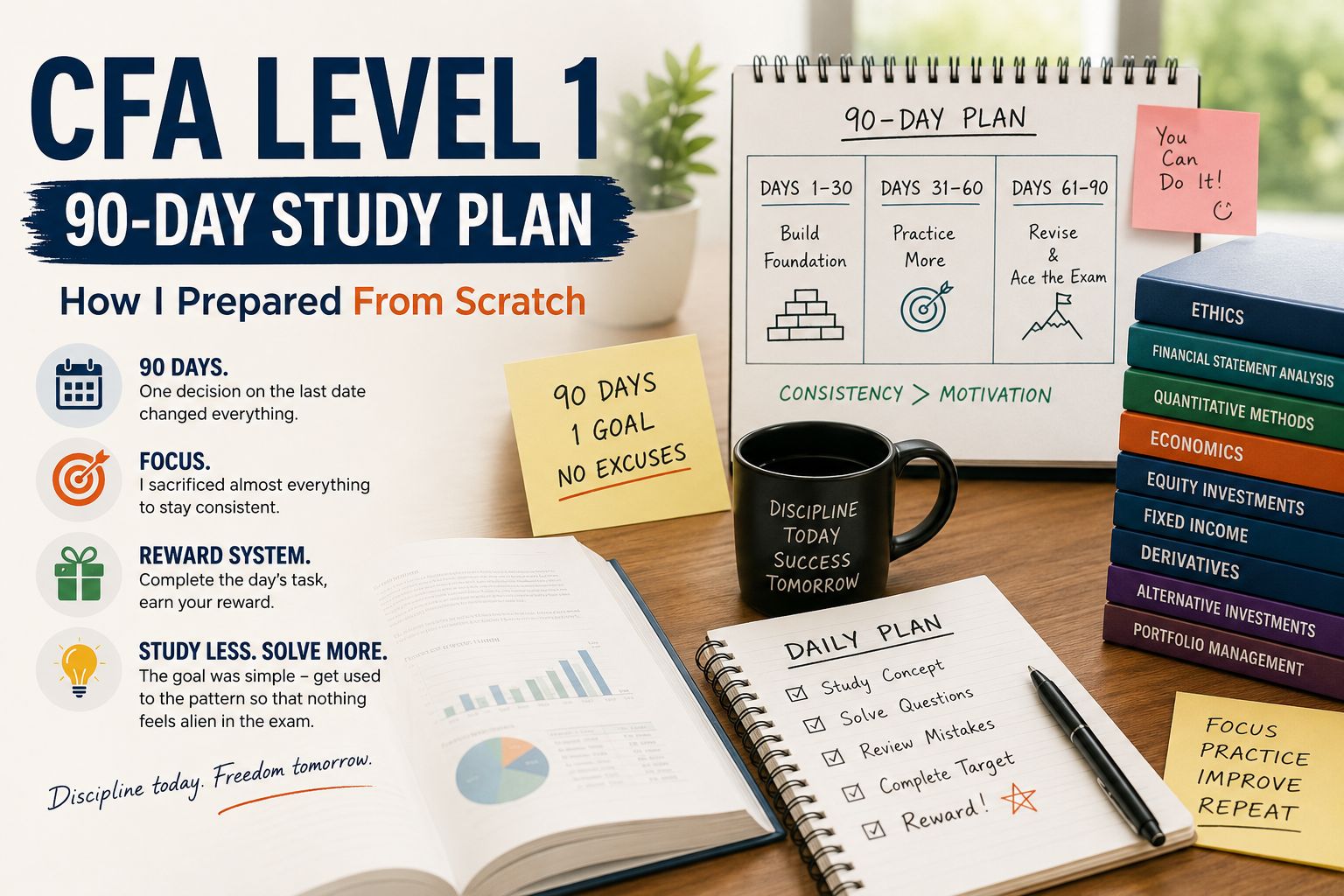
I had exactly 90 days to prepare for CFA Level 1.
Not because I had carefully planned a three-month study schedule.
I was working as a software engineer and filled out the CFA Level 1 exam form on the last day of registration.
And then reality hit me.
I had 90 days to cover a syllabus that looked enormous.
Coming from an engineering background, finance was almost a new language to me. I didn’t even properly understand terms like depreciation.
And Deferred Tax Liabilities (DTL)?
Those used to haunt me. 😄
Yet, 90 days later, I sat for the CFA Level 1 exam.
This is the approach I followed — and if you have around three months left for CFA Level 1, this is how I would approach it today.
First: Accept That 90 Days Is Not a Lot of Time
When you have six or nine months, you can afford to move slowly.
With 90 days, you can’t.
I realized very early that I couldn’t spend weeks trying to completely master every chapter before moving to the next one.
My goal became much simpler:
Cover the syllabus. Practice aggressively. Identify weaknesses. Improve. Repeat.
For those 90 days, CFA preparation became one of my biggest priorities.
I sacrificed a lot of things around me temporarily.
Less entertainment. Fewer unnecessary outings. Less wasted time.
It wasn’t about studying every waking hour.
It was about knowing that the clock was running.
The Reward System That Kept Me Going
One thing that helped me tremendously was a simple daily reward system.
Every day, I had a target.
It could be:
- Complete a particular reading.
- Revise yesterday’s concepts.
- Solve a certain number of questions.
- Finish a topic and practice its questions.
And I made a deal with myself:
Complete today’s target → earn today’s reward.
The reward didn’t have to be anything big.
It could be watching something I liked, eating something I wanted, playing a game, going out, or simply giving myself guilt-free free time.
But there was one important rule.
I had to honour the system.
If the day’s work wasn’t completed, I didn’t take the reward.
If it was completed, I took the reward without feeling guilty.
That made a 90-day goal feel much smaller.
Instead of constantly thinking:
“How am I going to finish the entire CFA Level 1 syllabus?”
I only needed to answer:
“What do I need to finish today?”
That change in mindset helped me enormously.
Study Less. Solve More.
If I had to summarize my CFA Level 1 preparation philosophy in four words, it would be:
Study less. Solve more.
Obviously, you need to understand the concepts.
But I didn’t want to spend all my available time reading and rereading.
I wanted to solve questions.
Lots of them.
Why?
Because CFA is not just a test of whether you have read the curriculum.
You need to recognize how concepts are converted into questions.
After solving enough questions, you start noticing patterns.
You understand what information matters.
You recognize common traps.
You become faster at eliminating incorrect options.
Most importantly, the exam starts feeling familiar.
That became one of my main objectives:
When I walked into the exam, I didn’t want questions to feel alien.
I might not know the answer to every question.
But I wanted to have seen enough questions that the style of questioning felt familiar.
That is why practice formed a huge part of my 90-day strategy.
My CFA Level 1 90-Day Strategy
I would divide the 90 days into three broad phases:
| Phase | Days | Primary Goal |
|---|---|---|
| Phase 1 | Days 1–50 | Learn concepts + immediately solve questions |
| Phase 2 | Days 51–70 | Finish syllabus + heavy question practice |
| Phase 3 | Days 71–90 | Revision + mixed practice + mock exams |
The exact number of days you spend on each subject can vary.
The principle matters more than the exact calendar:
Don’t separate studying and practicing.
If you study a concept today, solve questions on it today.
Days 1–50: Build the Foundation
During the first 50 days, the objective is simple:
Get through the major parts of the syllabus without getting stuck trying to achieve perfection.
For every topic, follow roughly the same process:
Learn → Solve → Review mistakes → Move forward
For example, if you’re studying Financial Statement Analysis, don’t wait until you’ve completed the entire subject before attempting questions.
Learn a concept.
Then solve questions.
If you keep getting something wrong, go back and understand it.
Then solve again.
This is particularly important if you’re coming from a non-finance background.
There will be concepts that initially make absolutely no sense.
I experienced this myself.
Don’t let one difficult topic consume three days because you’re determined to understand 100% of it before moving ahead.
Understand enough to progress.
Practice it.
Come back during revision.
Some concepts become much easier the second or third time you encounter them.
Days 51–70: Increase the Question Volume
By this point, you should have encountered most of the curriculum.
Now the balance should increasingly move from:
Learning → Practice
toward:
Practice → Identify weakness → Targeted learning → Practice again
Start mixing questions from different topics.
This matters because the real exam doesn’t tell you:
“You are now doing a chapter on depreciation.”
You need to identify what concept the question is testing.
That’s a different skill.
Mixed practice forces your brain to retrieve the concept instead of simply remembering what chapter you were studying five minutes ago.
Keep track of your mistakes.
Don’t just record whether an answer was wrong.
Ask:
Why did I get it wrong?
Was it because:
- I didn’t know the concept?
- I forgot a formula?
- I misunderstood the question?
- I made a calculation error?
- I fell for a tempting answer choice?
- I was rushing?
Your mistakes are effectively telling you what to study next.
Days 71–90: Turn Preparation Into Exam Preparation
The final 20 days shouldn’t feel like the first 20.
You’re no longer primarily trying to learn CFA Level 1.
You’re preparing to take the CFA Level 1 exam.
There’s a difference.
Start doing timed practice.
Solve mixed-topic questions.
Revisit weak areas.
Review formulas.
And most importantly, take mock exams.
A mock isn’t just there to give you a score.
It should diagnose your preparation.
After every mock, spend serious time reviewing it.
Separate your mistakes into three categories:
1. I didn’t know this
Go back and study the concept.
2. I knew this but forgot it
Add it to your revision/formula list.
3. I knew this but still got it wrong
This is often the most valuable category.
Maybe you misread the question.
Maybe you rushed.
Maybe you made a calculator error.
Maybe you changed a correct answer.
These mistakes won’t necessarily disappear by studying another chapter.
You need to recognize the behaviour causing them.
Don’t Treat Every CFA Level 1 Topic Equally
One thing I would be more systematic about today is topic weightage.
Some subjects contribute significantly more questions to the exam than others.
So your study time shouldn’t necessarily be divided equally across all subjects.
Pay particular attention to high-weight areas such as:
- Ethics
- Financial Statement Analysis
- Equity Investments
- Fixed Income
But don’t completely ignore smaller topics either.
A 90-day plan works because you’re trying to build a broad base of competence across the syllabus, not because you’re betting everything on a handful of subjects.
If You’re From Engineering or a Non-Finance Background
I want to emphasize this because I experienced it myself.
Don’t panic when basic finance terminology initially feels difficult.
Today, words like depreciation, deferred taxes, bonds, duration, working capital and financial ratios may sound completely normal to you.
When you’re encountering them for the first time, they don’t.
That’s okay.
You don’t need to become an accountant before you can understand Financial Statement Analysis.
You don’t need to become an economist before studying Economics.
And you don’t need a finance degree to start CFA.
Your first few weeks may simply require more patience.
Eventually, concepts that once seemed intimidating start becoming ordinary.
Yes, even DTL. 😄
What I Would NOT Do With Only 90 Days
I wouldn’t spend months making beautiful notes.
I wouldn’t repeatedly reread chapters just because reading feels productive.
I wouldn’t wait until finishing the entire syllabus before solving questions.
And I definitely wouldn’t postpone mock exams until the last possible moment.
With limited time, almost every study session should eventually lead to a question:
Can I actually solve this?
Because understanding something while reading it and retrieving it under exam conditions are two very different things.
A Simple Daily CFA Study Routine
If I were preparing again with 90 days available, my daily routine would be very simple.
Step 1 — Decide today’s target
Don’t sit down with the vague goal of “studying CFA.”
Define exactly what needs to be completed.
Step 2 — Learn the concept
Read/watch/study enough to understand the underlying idea.
Step 3 — Solve questions immediately
Don’t wait until tomorrow.
Test whether you actually understood it.
Step 4 — Review your mistakes
This is where a large part of the learning happens.
Step 5 — Complete the target
Finish what you committed to doing.
Step 6 — Take your reward
And honour it.
You earned it.
Tomorrow, repeat the process.
The Final 7 Days
During the final week, I would avoid trying to learn huge new areas unless absolutely necessary.
Focus on consolidation.
Days 84–85: Mock exam + detailed review
Days 86–87: Weak areas + formulas + frequently missed concepts
Day 88: Ethics + mixed question practice
Day 89: Light revision + selected difficult questions
Day 90: Very light review, exam logistics and rest
At this point, confidence matters too.
You don’t want to enter the exam mentally exhausted from trying to learn everything during the final 48 hours.
Is 90 Days Enough for CFA Level 1?
It can be.
But 90 days doesn’t leave much room for procrastination.
You need consistency.
You need to prioritize.
And, in my experience, you need to solve a lot of questions.
I started as a software engineer who barely understood basic accounting terminology.
Ninety days later, I was sitting for CFA Level 1.
The biggest lesson wasn’t that you need some extraordinary ability to cover the syllabus quickly.
It was much simpler:
Focus on today’s target. Complete it. Reward yourself. Then show up again tomorrow.
Do that for 90 days.
And solve enough questions that when exam day arrives, very little feels alien.
That’s the strategy that worked for me.
Ready to put this into practice? Start working through CFA Level 1 practice questions today.
Put this into practice
Start CFA Level 1 practice questions